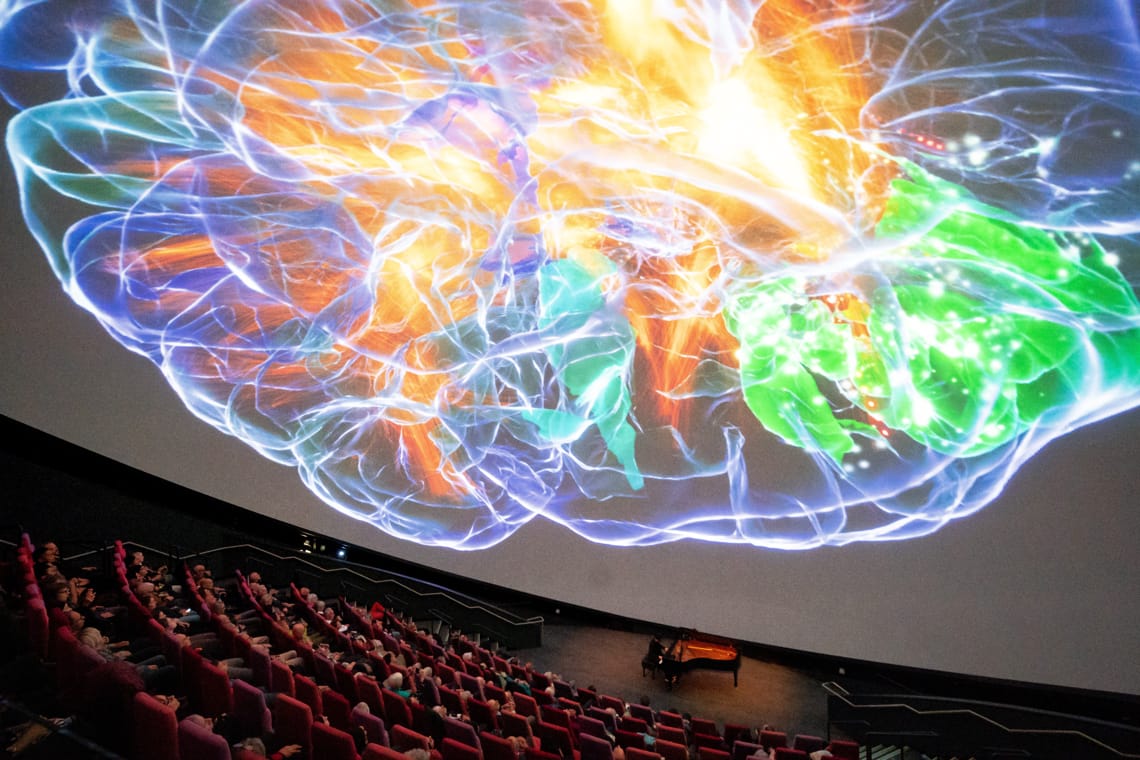
The Neurorecital pairs live piano performance with large‑scale visualizations of the performer’s brain activity. Audiences do not simply hear the music: they watch, in real time, how different musical structures, textures and expressive demands are reflected inside the pianist’s mind.
Developed by pianist Nicolas Namoradze in collaboration with leading neuroscience laboratories, the Neurorecital sits at the intersection of music, science, and visual art — rigorous in its research foundations, yet immediately accessible and compelling for a general audience.
A Neurorecital unfolds as a clearly structured, carefully paced experience. Each musical work is preceded by a concise spoken introduction, orienting the audience to both the music and the projected brain activity they are about to see.
During the performance itself, a large-scale projection above or behind the piano displays color-coded, three-dimensional visualizations of the pianist’s brain, synchronized precisely to the live music. The pianist performs live throughout; the visuals respond in real time through playback-alignment technology.
As the recital progresses, audiences begin to recognize clear contrasts:
The result is not a lecture or demonstration, but an enhanced listening experience — one that sharpens attention, deepens engagement, and encourages audiences to hear familiar repertoire in a new way.
The musical programme includes contrasting works drawn from composers such as Bach, Debussy, Scriabin, and others, chosen to highlight clear differences in neural and expressive profiles.
The Neurorecital can be presented as:
Critical reaction has highlighted both the immediacy of the experience and its broader implications:
“As a visual spectacle accompanying Namoradze’s pellucid playing, it was mesmerizing: an X-ray, seemingly, of virtuosity at work.”
The New York Times
“The audience is quite literally looking inside the performer’s mind… A beautifully engaging visualisation of how different kinds of music light up different parts of the brain.”
Financial Times
“This is not just a technological curiosity, but a genuinely new way of listening.”
BBC Music Magazine
“A multisensory experience that was equal parts concert, neuroscience demonstration, and philosophical inquiry… In a world increasingly shaped by technology, Neurorecital offers a rare synthesis of art and science — not as opposing forces, but as partners in discovery.”
Classic107
“Un esperimento che va oltre la spettacolarità: ci aiuta a comprendere interpretazione, cognizione e risposta emotiva alla musica.”
(“An experiment that goes beyond spectacle: it helps us understand interpretation, cognition, and emotional response to music.”)
la Repubblica (Il Venerdì)
The visual material is created using Glass Brain, a state‑of‑the‑art neural visualization platform developed by the Neuroscape Lab (University of California, San Francisco). Rather than relying on raw live EEG feeds — which are highly sensitive to movement — the project employs a novel methodology developed with Neuroscape and the Brain Dynamics Lab (University of Calgary).
Each work in the program is recorded many times under controlled conditions. These recordings are then precisely aligned and analysed, allowing stable, high‑resolution visualizations to be created in advance. During the concert, the visuals are synchronized to the live performance via playback‑adjustment technology, ensuring both scientific rigor and artistic freedom on stage.
This approach makes the Neurorecital one of the first projects to offer a reliable, detailed window into the neural activity of a performing musician — an area long considered methodologically inaccessible.
While much is known about how listening to music affects the brain, far less research has focused on the performer’s perspective. The Neurorecital addresses this gap, inviting audiences to reflect on interpretation, concentration, emotion, memory, and physical coordination — all unfolding simultaneously in performance.
For presenters, the project offers:
The Neurorecital received its world premiere at the Verbier Festival and has since been presented in contexts ranging from major music festivals to science centres and international summits, demonstrating its adaptability across artistic and institutional settings.
All video playback is managed by the artist using QLab software and a silent Bluetooth pedal system.